

What is react-to-pdf?
react-to-pdf is a versatile React library designed for client-side PDF generation directly from JSX-based components. Leveraging html2canvas and jsPDF under the hood, it efficiently transforms React component views into downloadable PDFs without server dependency.
Official documentation provides extensive examples and API references.
Alternative PDF libraries to generate PDF from React Components
Apart from react-to-pdf, other popular React-focused PDF libraries include:
- react-pdf: Render PDF documents from React components directly.
- html2pdf.js: Converts HTML content into PDF using a simplified API.
If you want to dive deeper into other JavaScript libraries to generate PDFs, we made a comparison of the best PDF javascript libraries in 2025.
Step 01: Setting up project (using Vite)
Initialize a new React project swiftly with Vite. Execute the following commands:
npm create vite@latest react-pdf-app -- --template react
cd react-pdf-app
npm install
npm install react-to-pdf
Step 02: Generating your first "Hello world" React PDF Component
Create a dynamic JSX component for PDF export, such as a basic invoice, using component props:
// PDFTemplate.jsx

export default function PDFTemplate({ customer, items }) {
  return (
    <div>
      <h1>Invoice</h1>
      <p>Customer: {customer}</p>
      <table>
        <thead>
          <tr>
            <th>Description</th>
            <th>Price</th>
          </tr>
        </thead>
        <tbody>
          {items.map((item, index) => (
            <tr key={index}>
              <td>{item.description}</td>
              <td>{item.price}</td>
            </tr>
          ))}
        </tbody>
      </table>
    </div>
  );
}
Integrate this component with react-to-pdf:
// App.jsx
import { usePDF } from "react-to-pdf";
import PDFTemplate from "./PDFTemplate";

function App() {
  const { toPDF, targetRef } = usePDF({ filename: "invoice.pdf" });

  const invoiceData = {
    customer: "John Doe",
    items: [
      { description: "Product 1", price: "$30" },
      { description: "Product 2", price: "$20" },
    ],
  };

  return (
    <div>
      <div ref={targetRef}>
        <PDFTemplate {...invoiceData} />
      </div>
      <button onClick={toPDF}>Download PDF</button>
    </div>
  );
}

export default App;
Advanced options of react-to-pdf
Customize your PDF outputs with advanced options:
- method (
saveby default): Defines action upon PDF generation (save,open, orprint). - resolution (default: 3 [Medium]): Controls the resolution scale of the generated PDF.
- canvas.mymeType (default: "image/jpeg"): Determines the image format for canvas generation.
- overrides: Allows overriding internal library configurations for
html2canvasandjsPDF.
Example:
const { toPDF, targetRef } = usePDF({
  filename: "customized.pdf",
  method: "open",
  resolution: 7,
  canvas: { mymeType: "image/png" },
  overrides: {
    // see https://artskydj.github.io/jsPDF/docs/jsPDF.html for more options
    pdf: {
      compress: true,
    },
    // see https://html2canvas.hertzen.com/configuration for more options
    canvas: {
      useCORS: true,
    },
  },
});Step 03: Running your product with Vite
Launch your React PDF generation project by running:
npm run devNavigate to http://localhost:5173 in your browser. Clicking the "Download PDF" button will save the PDF file directly to your device, unless the method is configured otherwise (e.g., "open" to preview in-browser).
Alternative: Generate PDFs with pdf noodle
Managing HTML-to-PDF conversion at scale can quickly become a nightmare!
Especially in serverless environments where cold starts, memory limits, and headless browser quirks love to break at the worst possible time (we even wrote a full article about it). Add constant template iterations, version control headaches, and the need to support non-technical contributors, and suddenly your “simple PDF library” turns into an ongoing engineering project.
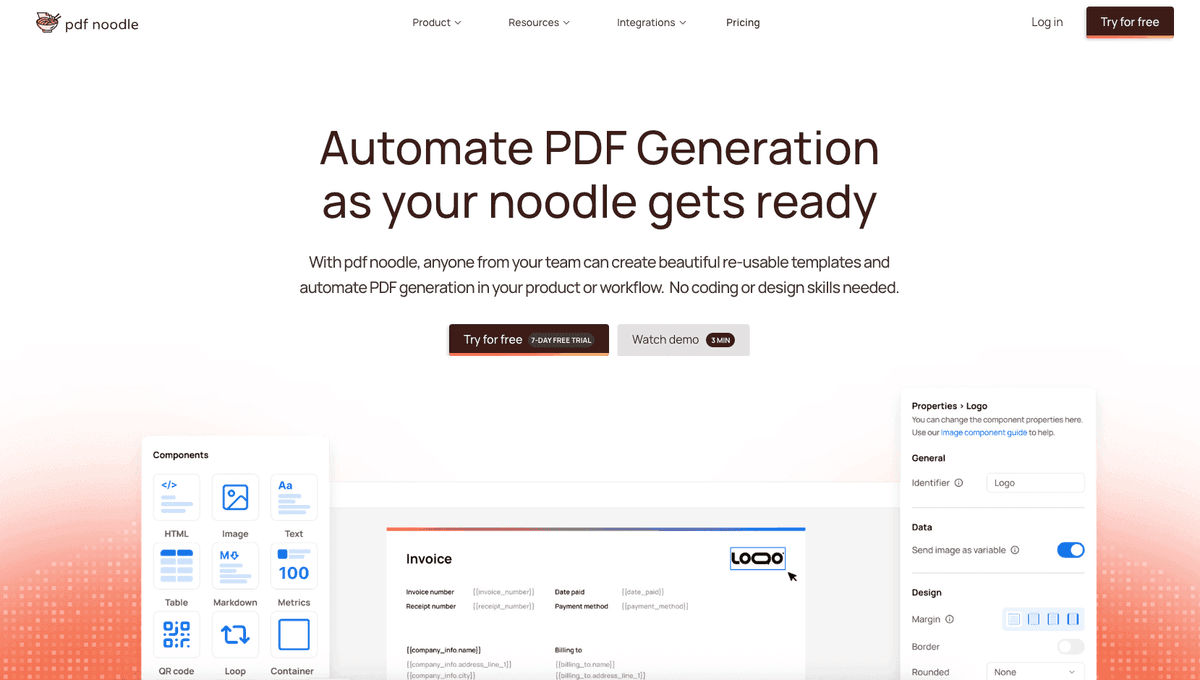
pdf noodle eliminates all of that.
Instead of maintaining brittle infrastructure or wrestling with outdated pdf libraries, pdf noodle gives you a battle-tested PDF generation API that just works!
Fast, scalable, and designed for both developers and non-developers. You send raw HTML or use our AI-powered template builder, and pdf noodle handles the rendering, scaling, optimization, and delivery so your team doesn’t have to.
Here's an example of a simple API request to generate your pixel-perfect PDF with just a few lines of code:
fetch("https://api.pdfnoodle.com/v1/html-to-pdf/sync", {
  method: "POST",
  body: JSON.stringify({ html: "your-html" }),
  headers: { Authorization: "Bearer your-api-key" },
});
pdf noodle also includes a powerful AI Agent that can generate PDF templates instantly, along with a modern editor for refining the design, also using AI, to match your brand. You don't need developing or design experience to quickly update layouts, adjust styling, and manage template versions.
Here’s a quick demo showing how it works:
You can create your account and design your first template without any upfront payment.
Conclusion
Choosing react-to-pdf simplifies client-side PDF generation directly from React components, although you’ll still need to handle layout breaks and some CSS incompatibilities due to jsPDF and html2canvas limitations.
If you don't want to waste time maintaining pdfs layouts and their infrastructure or if you don't want to keep track of best practices to generate PDFs at scale, third-party PDF APIs like pdf noodle will save you hours of work and deliver a high quality pdf layout.
Try it yourself: Need a quick conversion without writing code? Use our online HTML to PDF tool — no signup required.