

An Introduction to ReportLab: A Python PDF Generation Library
ReportLab is an open-source library for PDF generation in Python, known for its flexibility and precision when building complex, data-driven documents. It allows developers to create PDFs programmatically from scratch, offering deep customization for layouts, fonts, graphics, and tables.
Because of its powerful API, ReportLab is widely used in SaaS platforms and enterprise systems that require dynamic PDF creation, from invoices and financial statements to dashboards and analytical reports. Its robust, open-source foundation makes it ideal for developers who want full control over document design, going far beyond simple HTML-to-PDF conversion.
You can access the official documentation here.
Comparing ReportLab with other PDF Generation Python Libraries
When it comes to Python PDF generation, ReportLab stands out for its programmatic control and customization. It’s often compared with other libraries such as Pyppeteer, PyPDF2, Python PDFKit, and Playwright, each serving different needs depending on the type of PDF workflow you’re building.

ReportLab: Full Control and Customization
ReportLab allows you to create PDFs from scratch using Python objects, giving developers precise control over layouts, fonts, tables, and vector graphics. This makes it ideal for applications that need custom report generation or dynamically generated invoices and dashboards.
Pyppeteer and Playwright: HTML Rendering Engines
Both Pyppeteer and Playwright use a headless Chromium engine to render HTML pages into PDFs, ensuring pixel-perfect fidelity to your web designs. These tools are perfect when you already have an HTML template or need to export web reports directly as PDFs. However, they provide less flexibility for programmatic layouts or template-based design.
PDFKit: Simple HTML to PDF Conversion
PDFKit acts as a wrapper around wkhtmltopdf, offering a simple API for converting HTML or URLs to PDFs. It’s fast and easy to use but limited in styling and dynamic content control compared to ReportLab or Playwright.
PyPDF2: Manipulating Existing PDFs
PyPDF2 focuses on post-processing tasks such as merging, splitting, and encrypting PDFs. It’s not designed to generate documents from scratch, but rather to modify or combine existing files.
If your goal is to generate PDFs in Python with custom layouts, fonts, and data-driven content, ReportLab is the best choice. If you’d like a deeper analysis, check out our detailed guide comparing ReportLab, Playwright, and other Python PDF libraries in 2025.
Setting Up the Environment for PDF Generation with ReportLab
To start working with ReportLab, we need to install the necessary dependencies and create a project setup.
Installing ReportLab and Required Dependencies
Install the core ReportLab library using pip:
pip install reportlabIf you plan to parse or extract content from HTML before generating the PDF, also install lxml:
pip install lxml💡 Tip: ReportLab doesn’t convert HTML directly into PDFs like Playwright or PDFKit. Instead, you use Python objects (Paragraphs, Tables, Images, Drawings) to build PDFs programmatically.
A Quick Overview of Python ReportLab PDF Generation
ReportLab’s power lies in constructing PDFs programmatically, not just rendering static HTML.
- You create elements like Paragraphs, Tables, and Images using Python objects.
- You then build them into a “story” (a list of flowable components).
- ReportLab handles pagination, layout, and export to PDF automatically.
Here’s a minimal “Hello PDF” to test your setup:
from reportlab.lib.pagesizes import A4
from reportlab.pdfgen import canvas

pdf = canvas.Canvas("hello.pdf", pagesize=A4)
pdf.setFont("Helvetica", 14)
pdf.drawString(100, 750, "Hello, ReportLab PDF Generation!")
pdf.save()
Run it:
python pdf_generator.py✅ You’ll find a hello.pdf in your folder — proof that ReportLab is working.
Next, let’s dive into how to use ReportLab to generate fully structured, styled documents, including tables, charts, and HTML-inspired layouts.
Step-by-Step Guide: Create your PDF document using ReportLab
Before we start, install the packages:
pip install reportlab lxmlWe will cover both low-level canvas APIs and the Platypus high-level layout engine. This makes it easy to create a PDF in Python with ReportLab, from simple pages to multi-page reports.
Step one: Creating the PDF Canvas with basic components
The Canvas API is the most direct way to draw on a PDF. You control coordinates, fonts, colors, and shapes. This is perfect when you want pixel-precise placement.
1.1 Create a blank PDF and draw text and shapes
Heres the reportlab code example for it:
from reportlab.pdfgen import canvas
from reportlab.lib.pagesizes import A4
from reportlab.lib.units import mm
from reportlab.lib import colors

def create_basic_canvas_pdf(path="basic_canvas.pdf"):
    c = canvas.Canvas(path, pagesize=A4)
    width, height = A4  # points

    # Title
    c.setFont("Helvetica-Bold", 20)
    c.drawString(20 * mm, height - 20 * mm, "ReportLab PDF Generation: Canvas Example")

    # Body text
    c.setFont("Helvetica", 12)
    c.drawString(20 * mm, height - 30 * mm, "Hello from Python. This PDF was created using ReportLab's canvas.")

    # Line
    c.setStrokeColor(colors.HexColor("#333333"))
    c.setLineWidth(1.2)
    c.line(20 * mm, height - 35 * mm, width - 20 * mm, height - 35 * mm)

    # Rectangle
    c.setFillColor(colors.HexColor("#F5F7FA"))
    c.rect(20 * mm, height - 80 * mm, width - 40 * mm, 35 * mm, fill=1, stroke=0)

    # A simple footer
    c.setFillColor(colors.black)
    c.setFont("Helvetica-Oblique", 9)
    c.drawRightString(width - 20 * mm, 10 * mm, "Generated with ReportLab Python")

    c.showPage()
    c.save()

if __name__ == "__main__":
    create_basic_canvas_pdf()
What this does:
- Sets up A4 page size.
- Draws a title, a divider line, and a background rectangle.
- Adds a footer.
This is the most direct ReportLab create PDF approach.
1.2 Draw an image and automatic page breaks
Heres the code example:
from reportlab.pdfgen import canvas
from reportlab.lib.pagesizes import A4
from reportlab.lib.units import mm

def canvas_with_image(path="canvas_with_image.pdf", logo_path="logo.png"):
    c = canvas.Canvas(path, pagesize=A4)
    width, height = A4

    c.setFont("Helvetica-Bold", 16)
    c.drawString(20 * mm, height - 20 * mm, "Canvas with Image")

    # Draw an image at fixed size
    c.drawImage(logo_path, 20 * mm, height - 60 * mm, width=30 * mm, height=30 * mm, preserveAspectRatio=True, mask='auto')

    # Force a new page when needed
    c.showPage()
    c.drawString(20 * mm, height - 20 * mm, "Second Page")
    c.save()
Step two: Using more advanced components like tables or charts
For structured content that flows across pages, use Platypus. It provides Flowables such as Paragraph, Table, Image, and Spacer.
2.1 Build a multi-page document with Platypus
Heres how to do it:
from reportlab.platypus import SimpleDocTemplate, Paragraph, Spacer, Table, TableStyle, Image, PageBreak
from reportlab.lib.pagesizes import A4
from reportlab.lib.styles import getSampleStyleSheet, ParagraphStyle
from reportlab.lib import colors
from reportlab.lib.units import mm

def build_invoice_pdf(path="invoice_platypus.pdf", logo_path=None):
    doc = SimpleDocTemplate(
        path,
        pagesize=A4,
        rightMargin=20 * mm,
        leftMargin=20 * mm,
        topMargin=20 * mm,
        bottomMargin=20 * mm,
    )
    styles = getSampleStyleSheet()
    styles.add(ParagraphStyle(name="Small", fontName="Helvetica", fontSize=9, leading=12))

    story = []

    # Optional logo
    if logo_path:
        story.append(Image(logo_path, width=30 * mm, height=30 * mm))
        story.append(Spacer(1, 6 * mm))

    story.append(Paragraph("Invoice", styles["Title"]))
    story.append(Spacer(1, 4 * mm))

    meta = [
        ["Invoice #", "12345"],
        ["Date", "2024-10-07"],
        ["Client", "John Doe"],
        ["Due Date", "2024-11-07"],
    ]
    meta_tbl = Table(meta, colWidths=[30 * mm, 60 * mm])
    meta_tbl.setStyle(TableStyle([
        ("BACKGROUND", (0, 0), (-1, 0), colors.HexColor("#F0F0F0")),
        ("BOX", (0, 0), (-1, -1), 0.5, colors.HexColor("#DDDDDD")),
        ("INNERGRID", (0, 0), (-1, -1), 0.25, colors.HexColor("#DDDDDD")),
        ("ALIGN", (0, 0), (-1, -1), "LEFT"),
        ("FONT", (0, 0), (-1, -1), "Helvetica", 10),
    ]))
    story.append(meta_tbl)
    story.append(Spacer(1, 6 * mm))

    # Line items
    data = [
        ["Item", "Price"],
        ["Website Design", "$300.00"],
        ["Hosting (3 months)", "$75.00"],
    ]
    tbl = Table(data, colWidths=[100 * mm, 40 * mm])
    tbl.setStyle(TableStyle([
        ("BACKGROUND", (0, 0), (-1, 0), colors.HexColor("#EEEEEE")),
        ("TEXTCOLOR", (0, 0), (-1, 0), colors.HexColor("#333333")),
        ("ALIGN", (1, 1), (-1, -1), "RIGHT"),
        ("FONTNAME", (0, 0), (-1, 0), "Helvetica-Bold"),
        ("BOTTOMPADDING", (0, 0), (-1, 0), 8),
        ("GRID", (0, 0), (-1, -1), 0.25, colors.HexColor("#CCCCCC")),
    ]))
    story.append(tbl)
    story.append(Spacer(1, 6 * mm))

    story.append(Paragraph("<b>Total</b>: $375.00", styles["Normal"]))
    story.append(Spacer(1, 10 * mm))

    # Page break and terms
    story.append(PageBreak())
    story.append(Paragraph("Terms and Conditions", styles["Heading2"]))
    story.append(Paragraph(
        "Payment is due within 30 days. Please contact billing@example.com for questions.",
        styles["Small"]
    ))

    doc.build(story)

if __name__ == "__main__":
    build_invoice_pdf()
2.2 Add a simple chart (Bar chart) with ReportLab Graphics
ReportLab includes charting in reportlab.graphics. You can embed charts as Flowables.
from reportlab.graphics.shapes import Drawing
from reportlab.graphics.charts.barcharts import VerticalBarChart
from reportlab.graphics.widgets.markers import makeMarker
from reportlab.lib.colors import HexColor
from reportlab.platypus import SimpleDocTemplate, Spacer
from reportlab.lib.pagesizes import A4
from reportlab.lib.units import mm

def bar_chart_example(path="chart_example.pdf"):
    doc = SimpleDocTemplate(path, pagesize=A4)
    story = []

    d = Drawing(400, 200)

    data = [
        (300, 120, 90, 160, 200),  # Sales
    ]

    bc = VerticalBarChart()
    bc.x = 30
    bc.y = 40
    bc.height = 120
    bc.width = 320
    bc.data = data
    bc.strokeColor = HexColor("#333333")
    bc.barWidth = 20
    bc.groupSpacing = 10
    bc.categoryAxis.categoryNames = ["Jan", "Feb", "Mar", "Apr", "May"]
    bc.valueAxis.valueMin = 0
    bc.valueAxis.valueMax = 350
    bc.valueAxis.valueStep = 50

    # Optional marker on bars
    bc.bars[0].symbol = makeMarker("Circle")

    d.add(bc)
    story.append(d)
    story.append(Spacer(1, 10 * mm))

    doc.build(story)

if __name__ == "__main__":
    bar_chart_example()
Step three: Fix Fonts, Styling, Margins, Headers and Footers
To get professional output, set typography, page margins, and consistent headers and footers.
3.1 Register and use custom fonts
Here's how to do it:
from reportlab.pdfbase import pdfmetrics
from reportlab.pdfbase.ttfonts import TTFont
from reportlab.lib.styles import ParagraphStyle, getSampleStyleSheet

def register_fonts():
    pdfmetrics.registerFont(TTFont("Inter", "Inter-Regular.ttf"))
    pdfmetrics.registerFont(TTFont("Inter-Bold", "Inter-Bold.ttf"))

    styles = getSampleStyleSheet()
    styles.add(ParagraphStyle(name="InterBody", fontName="Inter", fontSize=11, leading=14))
    styles.add(ParagraphStyle(name="InterHeading", fontName="Inter-Bold", fontSize=16, leading=20))
    return styles
Tip: package the font files with your app or host them internally. This improves brand consistency for ReportLab PDF generation.
3.2 Add headers and footers with page callbacks
With SimpleDocTemplate, you can pass onFirstPage and onLaterPages to draw headers and footers on every page.
from reportlab.platypus import SimpleDocTemplate, Paragraph, Spacer
from reportlab.lib.pagesizes import A4
from reportlab.lib.units import mm
from reportlab.lib.styles import getSampleStyleSheet
from reportlab.pdfgen.canvas import Canvas

def _header_footer(canvas: Canvas, doc):
    width, height = A4
    canvas.saveState()
    # Header
    canvas.setFont("Helvetica", 9)
    canvas.drawString(20 * mm, height - 10 * mm, "Sample Company • Python ReportLab Generate PDF")
    # Footer with page number
    page_num = canvas.getPageNumber()
    canvas.drawRightString(width - 20 * mm, 10 * mm, f"Page {page_num}")
    canvas.restoreState()

def doc_with_header_footer(path="header_footer.pdf"):
    doc = SimpleDocTemplate(path, pagesize=A4, leftMargin=20*mm, rightMargin=20*mm, topMargin=20*mm, bottomMargin=20*mm)
    styles = getSampleStyleSheet()
    story = [Paragraph("Header and Footer Example", styles["Title"]), Spacer(1, 12)]
    story += [Paragraph("Content goes here. " * 30, styles["Normal"]) for _ in range(20)]
    doc.build(story, onFirstPage=_header_footer, onLaterPages=_header_footer)

if __name__ == "__main__":
doc_with_header_footer()PDF Examples for Python ReportLab Code
Below are two important patterns that many developers need when they search for reportlab python pdf example: page templates with frames, and mapping simple HTML to ReportLab flowables.
Using PageTemplates and DocTemplates
For complex layouts, use BaseDocTemplate + Frame + PageTemplate. This gives granular control over columns, margins, and repeating elements.
from reportlab.platypus import BaseDocTemplate, PageTemplate, Frame, Paragraph, Spacer
from reportlab.lib.pagesizes import A4
from reportlab.lib.units import mm
from reportlab.lib.styles import getSampleStyleSheet
from reportlab.pdfgen.canvas import Canvas

def header(canvas: Canvas, doc):
    width, height = A4
    canvas.saveState()
    canvas.setFont("Helvetica", 9)
    canvas.drawString(20 * mm, height - 10 * mm, "ReportLab PageTemplate Example")
    canvas.restoreState()

def footer(canvas: Canvas, doc):
    width, height = A4
    canvas.saveState()
    canvas.setFont("Helvetica-Oblique", 9)
    canvas.drawRightString(width - 20 * mm, 10 * mm, f"Page {canvas.getPageNumber()}")
    canvas.restoreState()

def build_with_templates(path="doc_templates.pdf"):
    doc = BaseDocTemplate(path, pagesize=A4)

    # Define frames (margins and columns)
    frame_main = Frame(20 * mm, 20 * mm, 170 * mm, 257 * mm, id='main')  # x, y, width, height

    # Page template with header and footer
    template = PageTemplate(id='main_template', frames=[frame_main],
                            onPage=header, onPageEnd=footer)
    doc.addPageTemplates([template])

    styles = getSampleStyleSheet()
    story = [Paragraph("Using PageTemplates and DocTemplates", styles["Title"]), Spacer(1, 6 * mm)]
    for i in range(50):
        story.append(Paragraph(f"Paragraph {i+1}. This shows flowing content inside a Frame.", styles["Normal"]))
        story.append(Spacer(1, 3 * mm))

    doc.build(story)

if __name__ == "__main__":
    build_with_templates()
Why this matters:
- You get magazine-like layouts.
- You can add multiple frames for multi-column pages.
- Headers and footers do not interfere with body frames.
Converting HTML to PDF using ReportLab
Important: ReportLab does not fully render arbitrary HTML and CSS like a browser. The Paragraph flowable supports a subset of inline markup such as <b>, <i>, <u>, <font>, <br/>, and simple lists. For more control, parse your HTML and map elements to Flowables.
1. Minimal example using supported inline markup
from reportlab.platypus import SimpleDocTemplate, Paragraph, Spacer
from reportlab.lib.styles import getSampleStyleSheet

def html_like_paragraphs(path="html_like.pdf"):
    doc = SimpleDocTemplate(path)
    styles = getSampleStyleSheet()
    story = []

    html_snippet = """
    <b>Invoice</b><br/>
    <font size="10">Client: John Doe</font><br/>
    <i>Date: 2024-10-07</i><br/>
    """
    story.append(Paragraph(html_snippet, styles["Normal"]))
    story.append(Spacer(1, 12))
    story.append(Paragraph("Line items and totals go below.", styles["Normal"]))

    doc.build(story)

if __name__ == "__main__":
    html_like_paragraphs()
2. Map a real HTML invoice to Flowables using lxml
This pattern reads your HTML and converts elements into ReportLab flowables. It is a common approach for python reportlab generate pdf when you have HTML sources.
from lxml import etree, html
from reportlab.platypus import SimpleDocTemplate, Paragraph, Spacer, Table, TableStyle
from reportlab.lib.styles import getSampleStyleSheet
from reportlab.lib import colors
from reportlab.lib.pagesizes import A4
from reportlab.lib.units import mm

def html_invoice_to_pdf(html_path="html_templates/invoice.html", out_path="invoice_from_html.pdf"):
    with open(html_path, "r", encoding="utf-8") as f:
        html_content = f.read()

    tree = html.fromstring(html_content)
    styles = getSampleStyleSheet()
    doc = SimpleDocTemplate(out_path, pagesize=A4, leftMargin=20*mm, rightMargin=20*mm, topMargin=20*mm, bottomMargin=20*mm)
    story = []

    # Title
    h1 = tree.xpath("//h1/text()")
    if h1:
        story.append(Paragraph(h1[0], styles["Title"]))
        story.append(Spacer(1, 6 * mm))

    # Invoice meta (example mapping for two-column rows)
    meta_rows = []
    for tr in tree.xpath("//table[contains(@class, 'details')][1]//tr"):
        tds = [td.text_content().strip() for td in tr.xpath("./td")]
        if len(tds) == 2:
            meta_rows.append([tds[0], tds[1]])
    if meta_rows:
        meta_tbl = Table(meta_rows, colWidths=[80 * mm, 80 * mm])
        meta_tbl.setStyle(TableStyle([
            ("BACKGROUND", (0, 0), (-1, 0), colors.HexColor("#F7F7F7")),
            ("BOX", (0, 0), (-1, -1), 0.5, colors.HexColor("#DDDDDD")),
            ("INNERGRID", (0, 0), (-1, -1), 0.25, colors.HexColor("#DDDDDD")),
            ("FONT", (0, 0), (-1, -1), "Helvetica", 10),
        ]))
        story.append(meta_tbl)
        story.append(Spacer(1, 6 * mm))

    # Items table (assuming the second .details table contains items)
    item_table = tree.xpath("//table[contains(@class, 'details')][2]")
    if item_table:
        rows = []
        for tr in item_table.xpath(".//tr"):
            cells = [td.text_content().strip() for td in tr.xpath("./td")]
            if cells:
                rows.append(cells)
        item_tbl = Table(rows, colWidths=[100 * mm, 40 * mm])
        item_tbl.setStyle(TableStyle([
            ("BACKGROUND", (0, 0), (-1, 0), colors.HexColor("#EEEEEE")),
            ("GRID", (0, 0), (-1, -1), 0.25, colors.HexColor("#CCCCCC")),
            ("ALIGN", (1, 1), (-1, -1), "RIGHT"),
            ("FONTNAME", (0, 0), (-1, 0), "Helvetica-Bold"),
        ]))
        story.append(item_tbl)
        story.append(Spacer(1, 6 * mm))

    # Totals
    total_text = tree.xpath("//table[contains(@class, 'totals')]//strong/parent::td/text()")
    if total_text:
        story.append(Paragraph(f"<b>Total:</b> {total_text[0].strip()}", styles["Normal"]))

    doc.build(story)

if __name__ == "__main__":
    html_invoice_to_pdf()
Notes and best practices:
- Keep your HTML predictable. Use classes that are easy to select with XPath.
- Map each HTML region to the appropriate Flowable.
- For complex HTML and full CSS fidelity, consider Playwright or Pyppeteer to render HTML as PDF. Use ReportLab when you need programmatic control and data-driven layout.
Alternative: Convert HTML to PDF Using pdf noodle
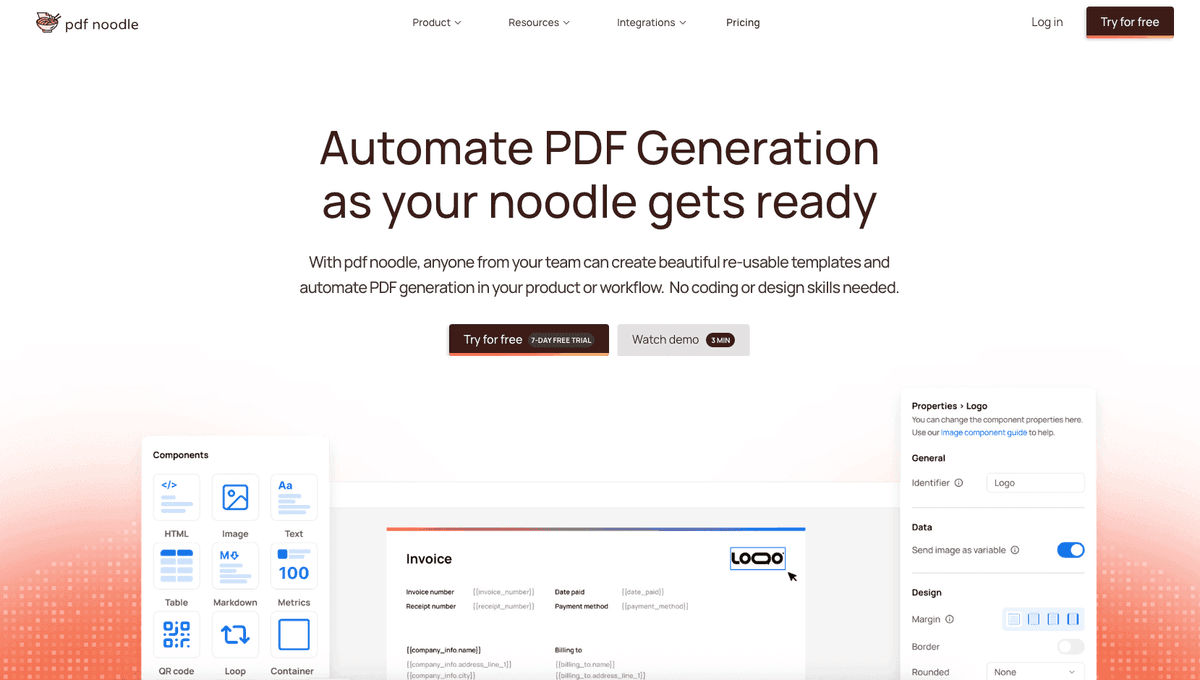
Managing HTML-to-PDF conversion at scale can quickly become a nightmare!
Especially in serverless environments where cold starts, memory limits, and headless browser quirks love to break at the worst possible time (we even wrote a full article about it). Add constant template iterations, version control headaches, and the need to support non-technical contributors, and suddenly your “simple PDF library” turns into an ongoing engineering project.
pdf noodle eliminates all of that.
Instead of maintaining brittle infrastructure or wrestling with outdated pdf libraries, pdf noodle gives you a battle-tested PDF generation API that just works!
Fast, scalable, and designed for both developers and non-developers. You send raw HTML or use our AI-powered template builder, and pdf noodle handles the rendering, scaling, optimization, and delivery so your team doesn’t have to.
Here's an example of a simple API request to generate your pixel-perfect PDF with just a few lines of code:
import requests

url = 'https://api.pdfnoodle.com/v1/html-to-pdf/sync'
payload = {
    "html": "<html>...your-html-here",
}
headers = {"Authorization": "Bearer YOUR_API_KEY"}

response = requests.post(url, json=payload, headers=headers)

with open('invoice.pdf', 'wb') as f:
    f.write(response.content)
pdf noodle also includes a powerful AI Agent that can generate PDF templates instantly, along with a modern editor for refining the design, also using AI, to match your brand. You don't need developing or design experience to quickly update layouts, adjust styling, and manage template versions.
Here’s a quick demo showing how it works:
You can create your account and design your first template without any upfront payment.
Conclusion
ReportLab remains one of the most powerful tools in the Python ecosystem for custom PDF generation. Its programmatic approach gives developers full control over every element: layouts, fonts, tables, and charts, making it ideal for building dynamic, data-driven, and branded documents at scale.
While libraries like Pyppeteer and Playwright excel at HTML-to-PDF rendering and PyPDF2 is best for manipulating existing PDFs, ReportLab shines when you need to create PDFs from scratch with precision and flexibility. It’s the preferred choice for developers who want structure and style to come directly from Python logic rather than static HTML templates.
If you don't want to waste time maintaining pdfs layouts and their infrastructure or if you don't want to keep track of best practices to generate PDFs at scale, third-party PDF APIs like pdf noodle will save you hours of work and deliver a high quality pdf layout.Conclusion
Try it yourself: Need a quick conversion without writing code? Use our free HTML to PDF tool — no code needed — no signup required.